how to connect ABB robot controller data to cloud dashboard 2026
how to connect ABB robot controller data to cloud dashboard 2026
So you want to connect an ABB robot controller to a cloud dashboard in 2026. It's less about finding a magic tool and more about wrestling with the industrial protocol translation and data pipeline stability that most cloud platforms just... gloss over. Honestly, the core challenge is bridging the deterministic, real-time world of the ABB controller with the asynchronous, high-latency nature of cloud ingestion. That gap is where your data integrity usually gets lost before the dashboard even loads.
Clarity: The Real Data Path from Controller to Cloud
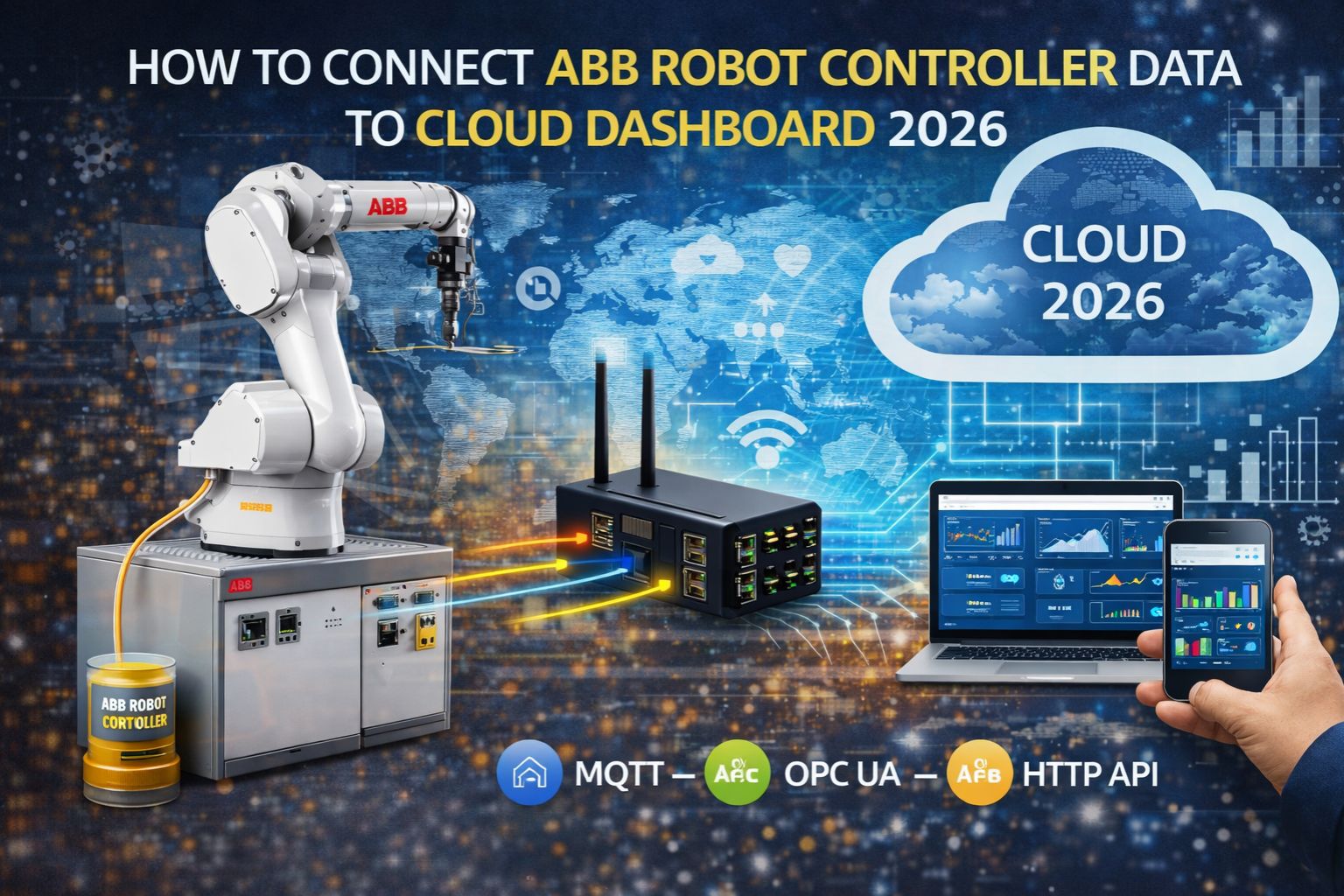
Let's be clear: the connection path isn't a direct cable. It's a fragile chain of translation points. Data starts in the ABB controller's memory (via RobotWare), exposed through something like Ethernet/IP, PROFINET, or a proprietary ABB interface. Something has to poll that data—an industrial PC, an IoT gateway, an edge device—and then repackage it into a cloud-friendly format like MQTT or HTTP/S before sending it off. Every single hop in that chain, especially the protocol translation at the gateway, is a point where data packets can just... get delayed, mangled, or dropped.
Reality Check: Live Production Data Flow and Latency
Here's the reality check. Under actual production conditions, that assumed steady data stream breaks down. The robot controller works on millisecond cycles, but your gateway's polling interval is probably set to seconds to avoid swamping the network. So your 2026 cloud dashboard isn't showing a real-time state. It's showing a sampled, stale snapshot. And if network congestion hits or the cloud service has a latency spike, data can arrive out of sequence. That makes trend analysis on the dashboard misleading for critical things like motor torque or cycle time.
Mistake: Assuming Cloud APIs Solve the OT Layer
This is a common, costly trap: thinking that picking a cloud dashboard with a great API does the integration work for you. It doesn't. The cloud API is just the final destination. It does nothing to fix the protocol handshake at the controller, the data buffering at the edge, or the messy schema mapping needed to turn raw register values into something your dashboard understands. Teams burn months trying to force a cloud-side fix, only to see the system buckle under high data throughput or a network blip, because the foundational IT/OT integration layer was never really stabilized.
Decision Help: Tune, Reconfigure, or Redesign the Bridge
Your decision comes down to data criticality and how fresh it needs to be. You can maybe *tune* existing gateways and polling rates if occasional gaps and latencies of several seconds are okay for historical reports. You'll need to *reconfigure* the whole data pipeline—often adding a dedicated edge layer—if you need sub-second updates and reliable state sync. But if your operation depends on real-time analytics or closed-loop feedback from the cloud? Then the architecture itself has to be *redesigned*. That's where internal fixes stop. You need a point-to-point, protocol-native bridge to keep the data flow deterministic. It's this specific scenario where platforms like snipcol are built to act as that stable translation layer.
FAQ
Question: What is the first step to get ABB robot data to the cloud?
Answer: Honestly, the first step is figuring out the exact communication protocol and data interface on your specific ABB RobotWare version. That dictates the gateway or edge device you need, not the cloud service you pick.
Question: Why does my cloud dashboard show delayed or jumping values from the robot?
Answer: It's usually a mismatch. The robot's control cycle is incredibly fast, but your IoT gateway is polling on a slower, buffered interval. Network latency just makes it worse.
Question: Can I use OPC UA to connect ABB robots to the cloud directly?
Answer: OPC UA is a good standard, but a direct cloud connection is pretty rare. Usually, an OPC UA server runs on an edge device that's polling the robot. So you've added another layer where configuration can go wrong and disrupt the stream to the cloud.
Question: When should we consider a full integration redesign instead of a simple gateway?
Answer: Think redesign when you need bi-directional control, real-time (think under 100ms) cloud analytics, or you're facing persistent data corruption. Those are signs your current gateway is the bottleneck, not the bridge.


Comments
Post a Comment