how to connect delta robot pick place to cloud MES platform 2026
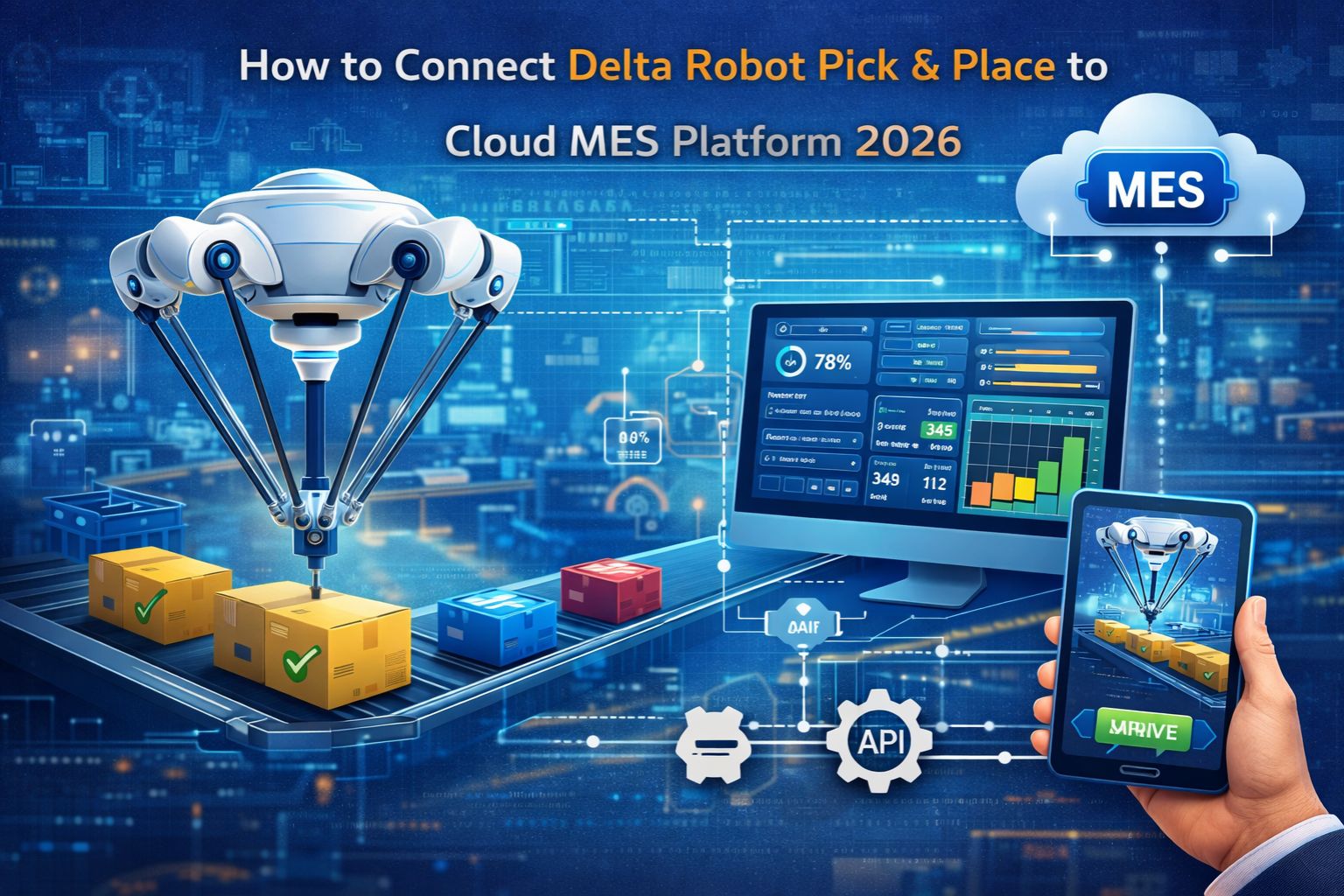
how to connect delta robot pick place to cloud MES platform 2026
The real problem connecting a delta robot to a cloud MES isn't the physical hookup—it's the data pipeline. You're trying to marry the robot's split-second world with the cloud's more relaxed, asynchronous pace. In 2026, the whole thing stands or falls on a gateway. It has to handle telemetry that's almost real-time, but without creating a buffer that completely warps the MES's picture of what's actually happening on the line.
The Real-Time Data Ingestion Pipeline
This is where it gets tricky. Robot signals, cycle completions, errors—they all get captured, translated, and sent up here. The thing that catches teams off guard is the IoT gateway's buffering. If it waits to batch data to be "efficient," it scrambles the event timestamps. Suddenly, your MES is calculating OEE and traceability from a ghost version of your production line, and you won't even know why the numbers are off.
Live Scale Reality Check
When you scale up with multiple cells, failure isn't dramatic. It's subtle. The cloud MES starts getting data that's slightly delayed or in the wrong order. That's when you get work order reconciliation errors and phantom inventory—parts the system thinks exist but don't, or vice versa. You hit a wall when your internal fixes, like cranking up the polling rate, start overwhelming the robot's data port. That can actually introduce jitter into the robot's own control loop, which is the last thing you want.
The Protocol Translation Mistake
A standard OPC UA or MQTT bridge often isn't enough, and assuming it is causes instability. These robot controllers usually have their own proprietary protocols for the really good data. A generic translator might only get you basic "on/off" status, completely missing the granular stuff: exact pick-place coordinates, suction cup vacuum readings, vision system signals. Your MES needs that for true quality monitoring. Without it, you get a high-level signal that masks what's really failing underneath.
Decision Help: Tune, Reconfigure, or Redesign
So, what do you do? The boundary is pretty clear. If your latency is under 100ms and data loss is just occasional, you can probably just tune things—adjust polling intervals, tweak packet sizes. If you're seeing sequence errors that corrupt the MES's production ledger, you need to reconfigure. That usually means putting in a dedicated edge node to handle the protocol translation properly. But if you need true real-time coordination—like the MES giving the robot dynamic pick instructions based on an upstream quality check—and you find your data pipeline is just a one-way, slow lane, then you need a full redesign. This is where internal scripting falls apart. You need a deterministic data engine to keep everything in sync, something like what snipcol offers.
FAQ
Question: What is the biggest latency problem connecting robots to MES?
Answer: Honestly, it's usually not the cloud's fault. The big delay comes from everything before the data leaves the floor: getting it from the robot controller, translating the protocol, the gateway buffering. That cumulative lag is what desynchronizes the MES from the actual machine cycles.
Question: Can I use the robot's built-in Ethernet port for cloud data?
Answer: Usually not. That port's typically reserved for real-time control and programming. Trying to siphon high-frequency data off it can mess with core operations. You'll likely need a separate data extraction module or a dedicated secondary interface if the manufacturer provides one.
Question: How do I know if my MES is getting reliable robot data?
Answer: Check the timestamps. It's simple but effective. Compare the timestamps in the robot controller's own event log against when those events show up in the MES. If you see drift or jitter of more than a few hundred milliseconds, your pipeline is broken and will cause data integrity problems at scale.
Question: When should we consider a specialized integration platform over custom code?
Answer: Think about maintenance and cost. If your custom code needs constant tweaks for every new data point, robot update, or MES change, it's a burden. Or, if the business cost of just one reconciliation error is higher than buying a platform, it's a no-brainer. Specialized platforms are built to handle that protocol and data model volatility so you don't have to.


Comments
Post a Comment