SCARA robot cycle time data to OPC UA cloud integration 2026
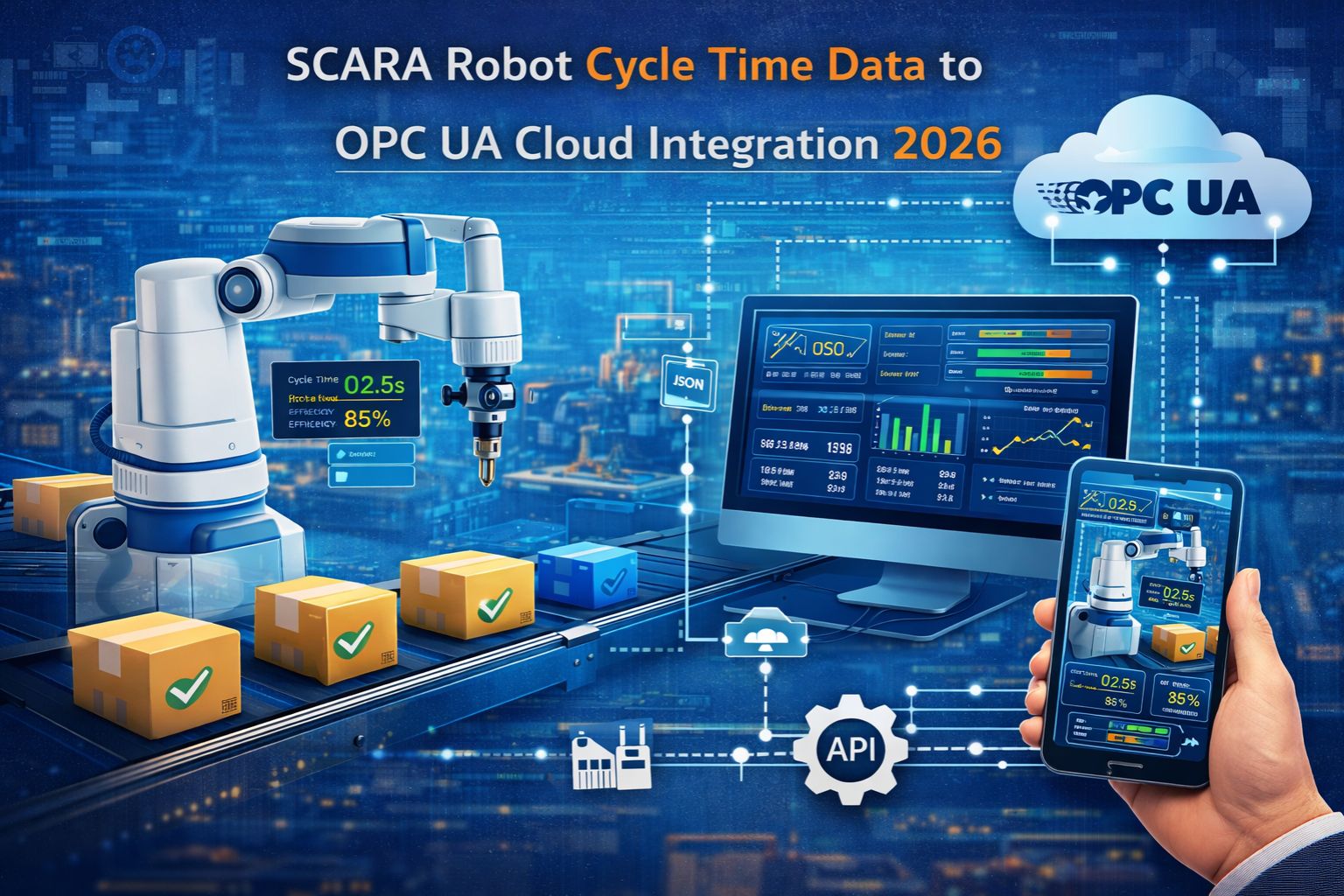
SCARA robot cycle time data to OPC UA cloud integration 2026
So you're looking at integrating SCARA robot cycle time data into an OPC UA cloud setup by 2026. There's a critical protocol mismatch here that's easy to miss. You've got high-frequency, deterministic data from the robot controller running straight into the buffered, session-based nature of OPC UA. That creates a built-in latency floor—a minimum delay you just can't tune out—and it corrupts any real-time performance analytics you're after. The failure isn't obvious; data doesn't just vanish. Instead, you get a time-domain distortion. Cycle time stamps become unreliable, which makes predictive maintenance and line balancing algorithms drift. And they drift silently. Teams often overlook that the robot's internal clock and the OPC UA server's timestamp operate on completely different resolution layers. It's a detail you ignore until your OEE calculations start showing variances that just shouldn't be possible.
The Real-Time Data Gap in 2026 Automation
Here's the clarity issue: "cycle time" isn't one neat data point. It's a stream of micro-timings—pick, place, dwell, retract—each with sub-millisecond precision. When you push that through a standard OPC UA client-server model, say for cloud IoT bridge ingestion, you're adding buffering and packetization delays. Those delays smear the temporal relationships between events. In a live environment, this shows up on your analytics dashboards. They'll display "average" cycle times that are statistically correct but operationally useless. Why? Because the variance data—the very thing that signals tool wear or alignment drift—gets averaged out by the protocol translation layer. You lose the signal in the process.
When Latency Breaks Production Visibility
The reality check hits at scale. With multiple robots on a line, these micro-delays don't just add up; they compound. OPC UA's subscription and publishing mechanisms were designed for plant-floor interoperability, not for the bursty, high-frequency telemetry of robotic cycles. The system won't fail outright. It's more insidious. Data arrives in chunks, causing your cloud-based monitoring to lag behind the physical line by several cycles. That delay kills any chance of real-time intervention, turning what should be a live performance tool into a historical report. There's also a non-obvious detail: gateway CPU throttling during peak data bursts. Internal buffers overflow and start dropping the oldest packets—which are often the exact data points you need for trend analysis.
The Silent Mistake in Protocol Assumptions
This is the common, costly mistake: assuming OPC UA's "unified architecture" inherently supports all time-series data at any frequency. Teams design the integration believing the protocol will handle the transport. Then they discover the OPC UA information model and the robot's native data structure—often a proprietary or MODBUS/TCP wrapped format—require a complex, stateful mapping. And that mapping layer itself becomes a source of jitter. The core misunderstanding causing all this instability is treating cycle time as a simple "tag" to be read, rather than a high-integrity event stream. That stream has to preserve its original timing context all the way from the controller's register to the cloud timeseries database.
Redesign the Data Pipeline, Don't Just Tune It
The decision boundary here is actually pretty clear. If your requirement is true real-time visibility for something like line synchronization or closed-loop quality control, then internal fixes won't cut it. Adjusting OPC UA publish intervals or upgrading gateway hardware is insufficient. You have to redesign the data pipeline. That means implementing a protocol-aware edge agent. This agent needs to consume the robot's native data stream right at the source, perform time-normalization and lightweight aggregation, and then package it into an OPC UA compatible format optimized for cloud ingestion. This is the boundary where specialized integration nodes become necessary. If you keep tuning past this point, you're only masking the fundamental architecture mismatch. It's a scenario where you need to evaluate the entire data path from controller to cloud, which is the contextual approach a service like snipcol would take.
FAQ
Question: What causes SCARA robot data to delay in OPC UA cloud systems?
Answer: The delay is caused by a protocol architecture mismatch. The robot's deterministic, high-speed data stream hits the buffered, session-based communication model of OPC UA, adding latency at the gateway and during cloud ingestion, which distorts time-sensitive metrics.
Question: Can you fix SCARA to OPC UA latency with better network hardware?
Answer: Not fully. While better switches and local processing can reduce some network jitter, the core issue is the protocol translation and data modeling overhead. Hardware alone cannot resolve the inherent timing mismatch between the robot's real-time data and OPC UA's communication patterns.
Question: How does this integration failure affect predictive maintenance?
Answer: It renders predictive models unreliable. Smeared or delayed cycle time data obscures the subtle, incremental lengthening of specific motion segments that indicate mechanical wear or calibration drift, causing models to miss failures or generate false alerts.
Answer: The decision point is when you need cycle time data for real-time line balancing or synchronous quality checks. If your use case is purely historical reporting, tuning may suffice. If you need live actionability, a redesign using an edge-based protocol normalization layer is required to preserve data fidelity.


Comments
Post a Comment