Snipcol Unified Namespace — Smart Factory Ready Week One 2026
Snipcol Unified Namespace — Smart Factory Ready Week One 2026
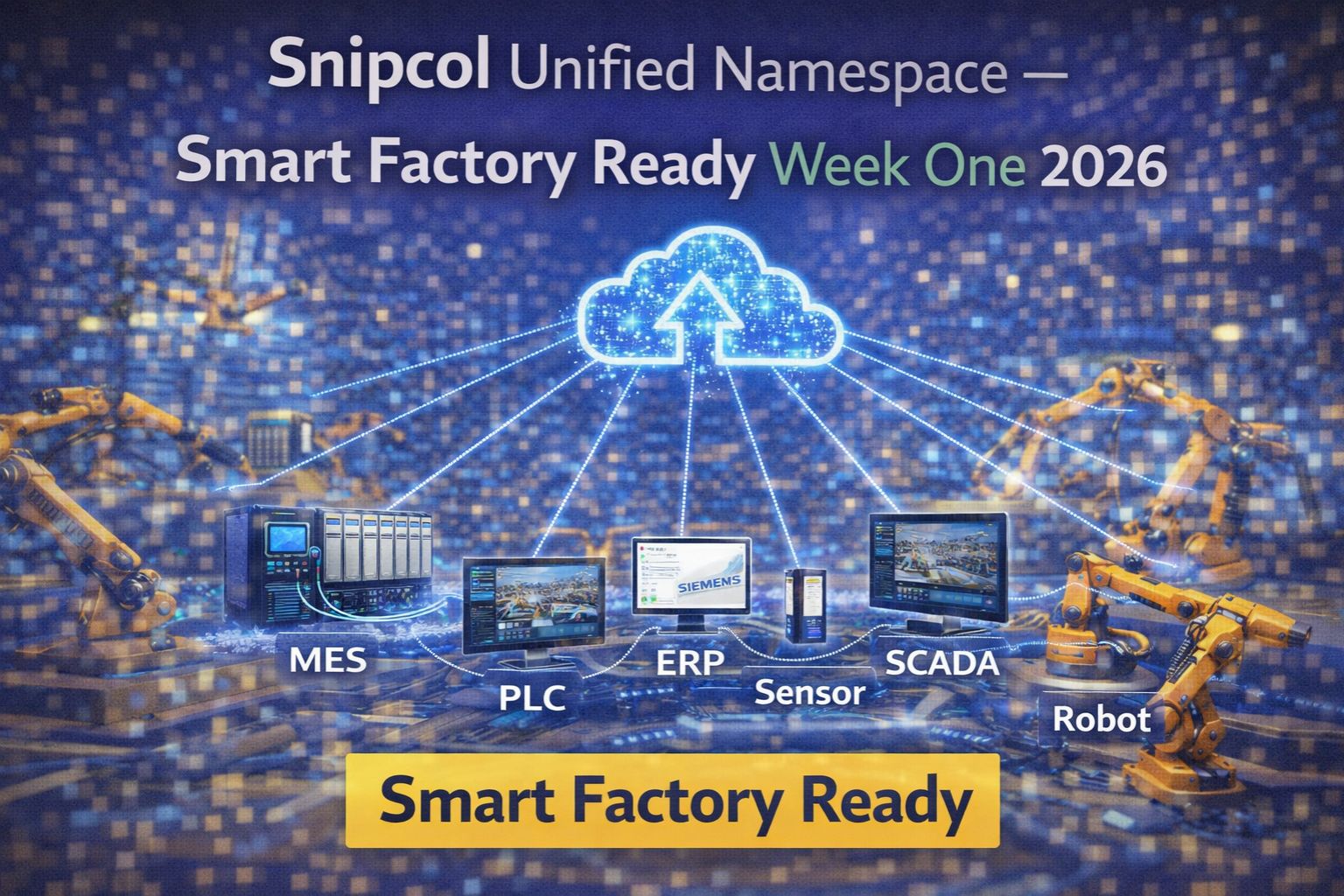
Look, if you're starting a smart factory project, deploying a unified namespace isn't just a good first step—it's the critical one. It sets up that single, authoritative source of truth for all your machines and data from the very beginning. This isn't just pulling numbers into a spreadsheet. A real foundational layer, like the one snipcol implements, enforces a consistent data model across everything from ancient PLCs to new cloud apps. It directly tackles the semantic chaos that kills analytics projects before they start. The real challenge, though, isn't making the first connection. It's whether the namespace can keep its context and governance when real, live production data starts pouring in at scale. That's the boundary where a lot of internal data lake projects just... stall out.
What a Unified Namespace Actually Means on the Factory Floor
So what is this thing in practice? It's not a fancy label for a data historian. It's an active governance layer. It maps a vibrating motor's RPM, a batch controller's setpoint, and an AGV's location into a coherent, queryable hierarchy where the relationships are actually defined. Here's the operational detail teams often miss: its role in protocol translation. It doesn't just store OPC UA nodes and Modbus registers. It *understands* that "Line1.Press.Temp" from one system and "Press_01_Temperature" from another are the same physical thing. It resolves those asset naming mismatches that cripple dashboard builds for months. Honestly, that semantic resolution is what actually separates a connected factory from a smart one.
The Reality of Going Live with a New Data Foundation
When you finally flip the switch and the namespace goes live, that first wave of data is revealing. It exposes hidden dependencies and legacy assumptions you didn't know you had—like a critical quality sensor that polls at 100ms but has been logged at 1-second intervals, creating a total blind spot for real-time alerts. And at industrial scale, the namespace has to handle a dual workload that stresses most middleware: simultaneous ingestion from thousands of tags with low-latency access for control loops, *and* high-throughput batching for analytics. The big misunderstanding? Thinking that once assets are named, the job's done. Instability creeps in when the namespace's contextual rules aren't automatically applied to new devices. You can watch data silos re-form within weeks if you're not careful.
The Critical Mistake: Treating it as a One-Time IT Project
The primary risk here is treating the unified namespace like a one-time mapping exercise, led by IT without continuous OT input to validate the context of live process data. That creates a brittle layer. It breaks when production changes over to a new product line or brings in a new machine, because a static namespace can't infer new tag relationships. You'll see failure patterns emerge—like alarm logic written against the namespace failing because a gateway's packet buffering during network congestion introduces jitter, making state transitions look illogical. The breaking point, where internal fixes stop working, is when the rate of change in the physical factory—new assets, modified recipes, updated SOPs—simply outpaces the manual update cycle of the namespace's governance rules.
Decision Help: Integrate, Govern, or Redesign
So your decision boundary is pretty clear. You can try to tune the ingestion pipelines for better performance. You can reconfigure the governance rules to be more adaptive. Or, if the foundational data model itself is flawed, you might have to redesign the namespace architecture entirely. Internal fixes won't cut it when the namespace itself can't enforce data quality or lineage at the point of ingestion, or when it becomes a performance bottleneck for time-sensitive control. This is exactly where a purpose-built industrial integration layer proves critical. It moves beyond simple data aggregation to active governance. Platforms like snipcol are engineered for this reality, providing the protocol resilience and semantic consistency you need to maintain a trustworthy data foundation as factory complexity inevitably grows.
FAQ
Question: What is a unified namespace in simple terms?
Answer: Think of it as a standardized, hierarchical naming and organizational system for every piece of data in a factory. From a single sensor reading to a full production line's status. It ensures all your systems use the same "language" to find and understand data.
Question: Why does a unified namespace fail after initial deployment?
Answer: It usually fails because it's built as a static map. When you introduce new machines, sensors, or process changes without updating the namespace's context and rules, data gets orphaned or mislabeled. Then your reports and automations break.
Question: How does scale affect a unified namespace?
Answer: At scale, it has to manage millions of data points with millisecond latency for control, while also supporting bulk historical queries. Most failures happen under this dual load—gateway timeouts or buffering cause data loss or jitter that throws everything off.
Question: When should we consider a platform instead of building internally?
Answer: Consider a dedicated platform when the rate of change on your factory floor outstrips your team's ability to manually manage the namespace. Or when you need built-in protocol translation, data validation, and lineage tracking that generic IT tools just can't provide.


Comments
Post a Comment